
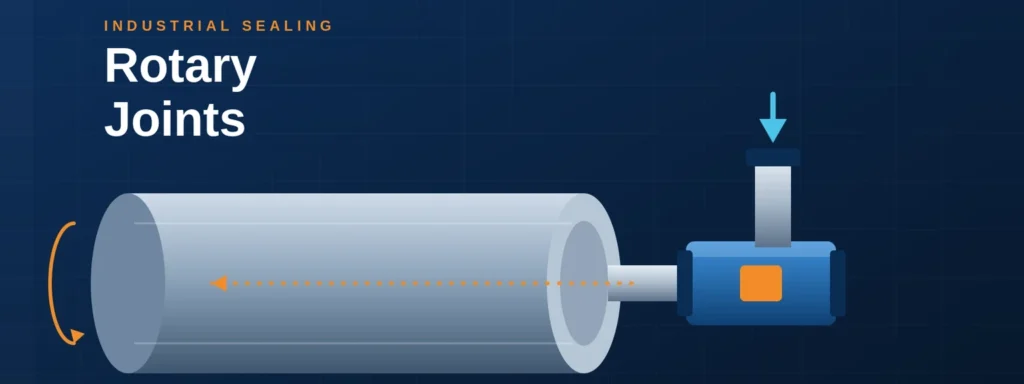
Imagine you need to feed steam into a drying cylinder. Here is the catch: the cylinder turns many times in a matter of seconds, while the steam line never moves. Connect the pipe directly and it will snap off on the first rotation. A rotary joint, also known in the field as a rotary union, is the part that bridges these two worlds.
In this article we explain what a rotary joint is, how it works, which types exist, and what to consider when choosing the right model for your application.
What Is a Rotary Joint?
A rotary joint is a sealing and connection element that transfers fluid from a stationary line into a moving (rotating) system. The fluid can be water, steam, hot oil, air or hydraulic oil. Depending on what it carries, it is called a water joint, a steam joint, a hot oil joint, and so on.
In short, its job is to deliver a heating or cooling medium into a rotating drum, cylinder or roller continuously and without leakage.
How Does a Rotary Joint Work?
A typical rotary joint has two main parts: a stationary housing and a rotating shaft attached to the cylinder. The fluid enters through the stationary housing, passes through the shaft and reaches the drum. The stationary and rotating surfaces run in very close, controlled contact, and this contact is also what stops the fluid from escaping between them.
In a well-designed joint the fluid reaches the drum without losing energy. Keeping the drum at the right temperature directly affects product quality, so this detail matters more than it seems.
Types of Rotary Joints

Our product groups are divided by the fluid they carry:
- Water joints (1000 series): Deliver cooling and heating water to the rotating drum.
- Steam joints (2000 series): Used on steam-heated drying cylinders.
- Steam joints with vacuum breaker (3000 series): A steam joint version equipped with a vacuum breaker.
- Air, hydraulic and cooling joints: Designed for compressed air, hydraulic oil and cooling lines.
- Air joints (4000 series): Preferred where compressed air is transferred into a rotating system.
- Water rollers (6000 series): Used to supply water to rotating rollers.
- Hot oil joints (7000 series): Work on high-temperature thermal oil lines.
You can find every model on our Rotary Joints product page. For applications that need a different kind of movement on the shaft, take a look at our swivel joint solutions as well.
How to Choose the Right Rotary Joint

You need four pieces of information to determine the right joint for your application. Each one affects a different design decision:
- Fluid type: Influences everything from the elastomer type to the face and material selection.
- Pressure: Affects which elastomer is used and how the housing is designed.
- Temperature: Affects the elastomer type, the face combination and the material selection.
- Speed: Affects the bearing, the face option, the overall design and the material.
Settling these four values up front prevents ordering the wrong product, and it prevents leakage and early wear in the field. If you don’t have exact values, just send us the nameplate details of your machine and the dimensions of your existing joint. Our team will take it from there.
Frequently Asked Questions
Is a rotary joint the same as a mechanical seal?
A rotary joint transfers fluid from a stationary line into a rotating system. A mechanical seal is usually mounted on the shaft of equipment such as pumps and mixers to provide sealing. They answer different needs. You can browse our Mechanical Seals page for the latter.
Which fluids can a rotary joint handle?
Water, steam, hot oil, air and hydraulic oil. The fluid type is the first deciding factor when choosing a model.
Which industries use rotary joints?
Textile, paper, automotive, iron and steel, packaging, plastics, rubber and food industries lead the way.
What information should I share to select a joint?
Fluid type, operating pressure, operating temperature and speed. With these four values we can quickly identify the right model.
Let’s choose the right rotary joint for your application together.
Not sure which joint suits your job? Our technical team is happy to help.
Phone: +90 212 549 73 25 | Email: support@rotaseal.com
Working hours: Monday–Friday, 07:30–17:30. You can also write to us through our contact page.
