
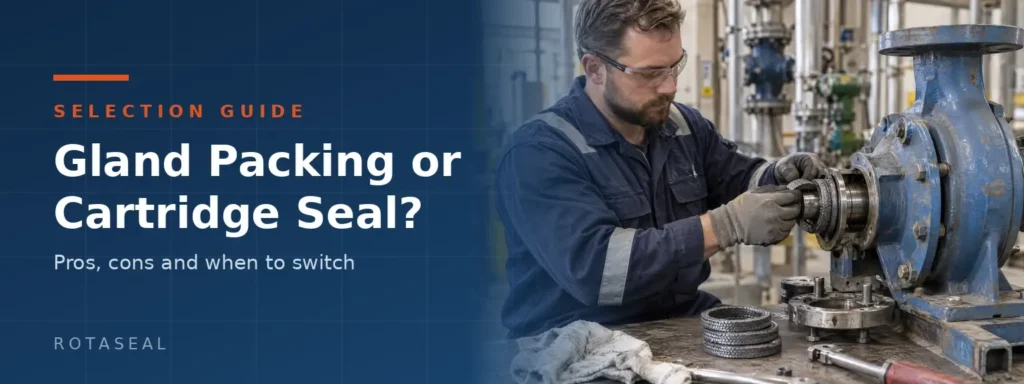
We all know those braided rings around a pump shaft. Gland packing, also called soft packing, is one of the oldest sealing solutions in industry, and it still runs in many plants today. So when does it do the job, and when does it wear you out? In this article we cover the pros and cons of gland packing, and then the cartridge seal you can use in its place.
What Is Gland Packing?
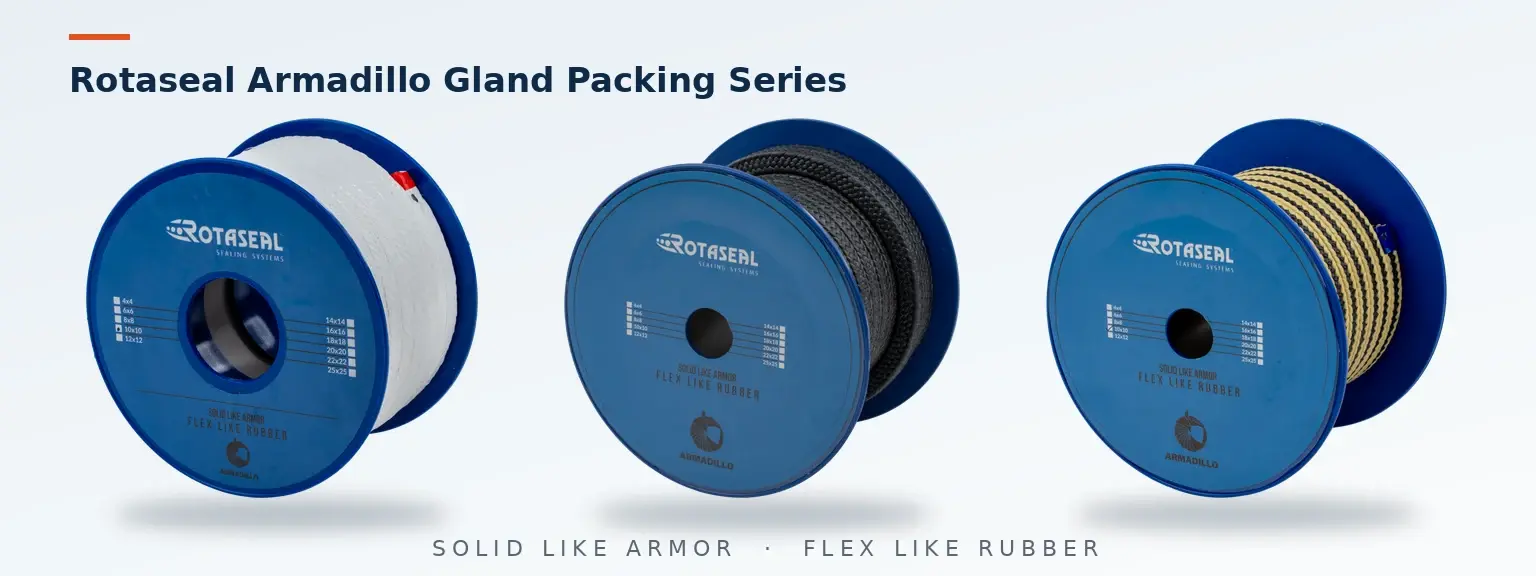
Gland packing is a sealing element made of rings braided from fibres such as PTFE, graphite or aramid. The rings are placed in the pump’s stuffing box and compressed by a part called the gland follower. The compressed rings fill the gap around the shaft and keep the fluid from escaping. In Rotaseal’s gland packings range you will find options in different materials and sizes.
How Does Gland Packing Work?
As the rings are tightened, they press against the shaft. A fully closed packing, however, heats and wears the shaft. That is why gland packing is deliberately set to leak a very small amount. This thin leakage cools and lubricates the packing. As the rings wear, the gland is tightened again to restore the setting. When the rings are fully compressed, the stuffing box has to be repacked.
Advantages of Gland Packing
- Low upfront cost: You start out cheaper than with a mechanical seal.
- Easy installation: Fitting the rings one by one needs no complicated preparation in most applications.
- Adjustable in service: If leakage grows, the gland can be tightened to correct it.
- Simple maintenance: No special equipment is needed, and it is easy to do on site.
- Wide material choice: Braids such as PTFE, graphite and aramid suit many different fluids.
Disadvantages of Gland Packing
- Leakage is part of the design: Zero leakage is not the goal. That means product loss, clean-up and environmental risk.
- Shaft and sleeve wear: The packing rides directly on the rotating surface. Over time the shaft or protective sleeve gets scored, which can be an expensive repair.
- Energy loss: Friction makes the pump draw more power.
- Frequent checks and adjustment: Regular tightening and eventual repacking are required.
- Risk of over-tightening: Tightened too much, the packing overheats, hardens and quickly damages the shaft.
- Not suitable for every fluid: With hazardous, toxic or volatile fluids, leakage is unacceptable.
What Can Replace Gland Packing? Cartridge Seals
If leakage, wear and constant adjustment from gland packing are costing you, the natural alternative is a cartridge mechanical seal. A cartridge seal arrives as a single unit, fully assembled and set at the factory. This lowers the risk of installation errors and speeds up replacement.
- Much less leakage: Leakage is down at the level of an almost invisible film.
- Low shaft and sleeve wear: Sealing happens between two faces, not on the shaft itself.
- Less maintenance: No constant gland adjustment is needed.
- Faster, safer installation: As a ready unit, the risk of setting errors is lower.
The downsides are a higher upfront cost than gland packing and the fact that the pump must be taken out of service for replacement. But once you add up product loss, energy, maintenance and downtime, the total cost often favours the cartridge seal.
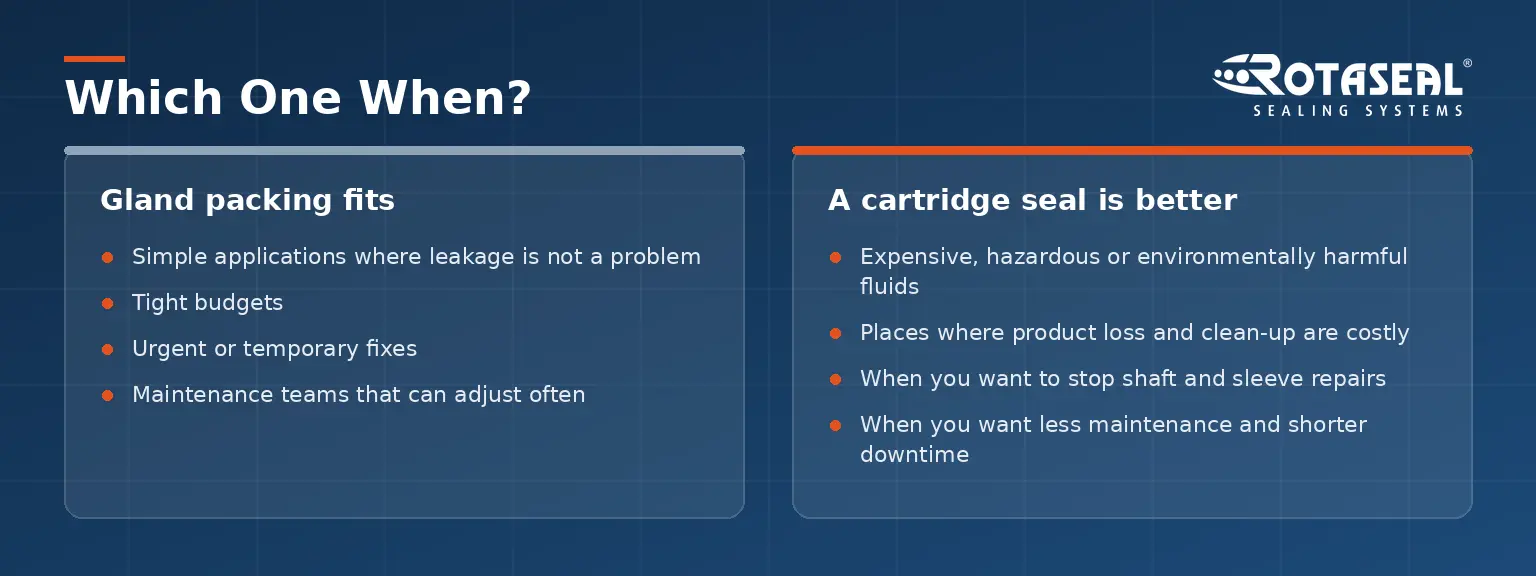
Which One When?
Switching from Gland Packing to a Cartridge Seal
The switch is often possible, but check these first:
- Do the stuffing box dimensions suit a cartridge seal?
- Is the shaft or sleeve surface worn or scored? After years on gland packing, machining or a new sleeve may be needed.
- What are the fluid type, pressure and temperature?
- Is a flush or buffer fluid system required?
If you are unsure, send us the pump type and shaft dimensions and we will work out the right solution together.
Frequently Asked Questions
How much should gland packing leak?
The target is not zero leakage but a slow, steady drip. A packing left completely dry overheats and damages the shaft.
When should gland packing be replaced?
When leakage can no longer be controlled by tightening the gland, or the rings are fully compressed, it is time to repack.
Can I switch from gland packing to a cartridge seal?
Often yes. If the stuffing box dimensions and the shaft or sleeve condition are suitable, the switch can be made. A worn shaft may not allow a direct switch without machining.
Let’s choose the right sealing solution together.
Phone: +90 212 549 73 25, email: support@rotaseal.com. Browse our gland packings, cartridge and agitator type seals and buffer/barrier fluid systems. Related reading: What Is a Mechanical Seal? and Why Do Mechanical Seals Leak?
